April 15, 2026
What is proof of address (POA)? A complete guide
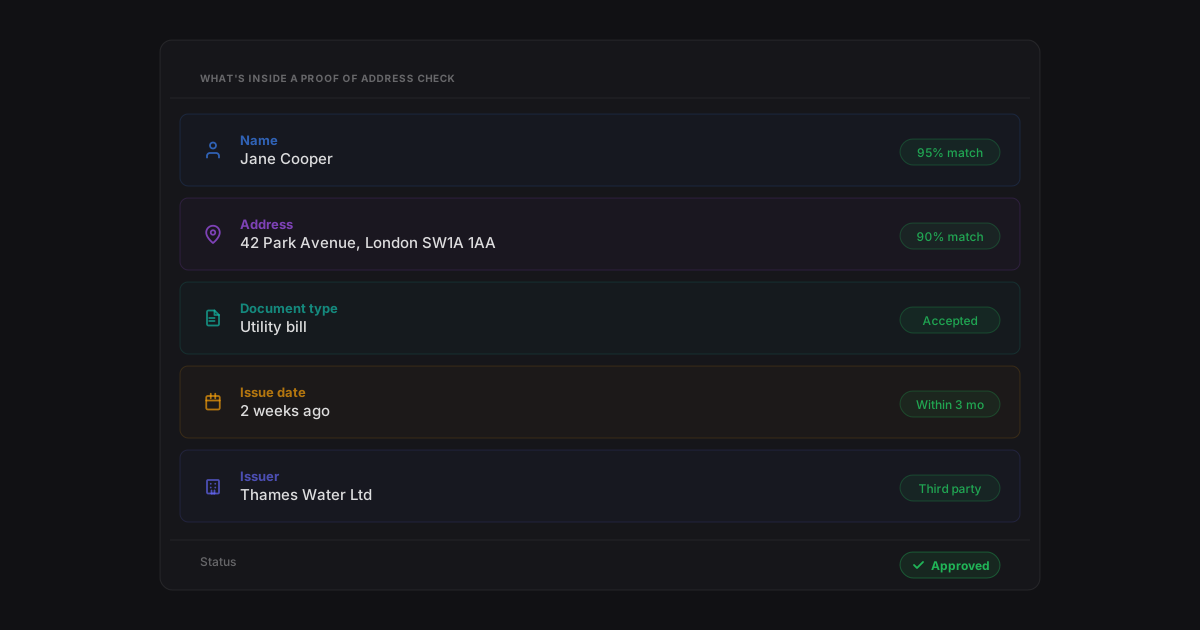
Proof of address is a document that confirms where a person lives. Businesses, governments, and financial institutions use it to verify that a customer, applicant, or citizen actually resides at the address they claim. It is one of the core components of know your customer (KYC) processes and anti-money laundering (AML) compliance.
You will also see it referred to as POA, proof of residency, or address verification. The terms are used interchangeably, though "proof of residency" sometimes carries a legal distinction in immigration contexts.
Why is proof of address required?
Organisations require proof of address for several reasons:
- Regulatory compliance. Financial institutions, fintechs, crypto exchanges, and other regulated businesses are legally required to verify customer addresses as part of KYC and AML obligations. Failing to do so can result in fines, sanctions, and loss of operating licences.
- Fraud prevention. Confirming a real residential address makes it harder for fraudsters to create fake accounts or use stolen identities. An address ties a person to a physical location, which can be cross-referenced with other identity signals.
- Risk assessment. A customer's address determines their jurisdiction, which affects their risk profile. Certain countries or regions carry higher AML risk, and the address helps organisations apply the right level of due diligence.
- Service delivery. Beyond compliance, some businesses simply need to confirm an address to deliver a product, set up an account, or issue a contract. Property managers, insurers, and telecom providers all fall into this category.
Who requires proof of address?
Almost any organisation that onboards customers or provides regulated services may require proof of address. The most common include:
- Banks and financial institutions for account opening, loan applications, and ongoing due diligence
- Fintechs and neobanks for digital onboarding and compliance
- Crypto exchanges for KYC during registration and withdrawal
- Property managers and letting agents for tenant verification
- Insurance companies for policy applications
- Government agencies for ID issuance, voter registration, tax administration, and benefits
- Remittance and money transfer services for sender and receiver verification
- Telecom providers for SIM registration in some countries
Which documents qualify as proof of address?
The specific documents accepted vary by organisation and jurisdiction, but the most widely recognised are:
- Utility bills (gas, electricity, water, landline, internet) issued within the last 3 months
- Bank or building society statements showing the account holder's name and address
- Government-issued letters such as tax notices, council tax bills, voter registration confirmations, or social security correspondence
- Insurance documents including home or life insurance policy letters
- Mortgage statements from a mortgage provider
For a detailed breakdown of accepted and rejected document types, see what counts as proof of address.
What makes a valid proof of address document?
Regardless of which document type is used, a valid proof of address must typically meet these criteria:
- Shows the person's full name. The name on the document must match the name on the person's identity document (passport, national ID, or driving licence).
- Shows a residential address. PO boxes, workplace addresses, and registered agent addresses are generally not accepted.
- Is recent. Most organisations require documents issued within the last 3 months. Some accept up to 6 months. Annual documents like tax assessments may be accepted up to 12 months.
- Is issued by an independent third party. The document must come from a utility company, bank, government body, or similar institution. Self-created documents do not count.
- Is legible and complete. All relevant information (name, address, date, issuer) must be clearly readable. Blurry photos, cropped scans, or partially visible documents will be rejected.
Digital vs paper proof of address
As paper bills and statements disappear, digital documents have become the norm. PDF bank statements downloaded from online banking, e-bills from utility providers, and digital government correspondence are now accepted by most regulators and institutions worldwide.
The key distinction is between documents generated by the issuing institution (a PDF downloaded from your bank's portal) and documents created by the customer (a screenshot of a banking app or a printed webpage). The former is accepted. The latter is not.
For a detailed guide on digital proof of address, see do online bank statements count as proof of address?
Proof of address vs proof of identity
These two terms are often confused, but they serve different purposes in the verification process.
Proof of identity (POI) confirms who you are. It typically requires a government-issued photo ID such as a passport, national identity card, or driving licence. The document must include your name, photo, and usually a unique identifier (passport number, ID number).
Proof of address (POA) confirms where you live. It requires a recent document from an independent third party (utility bill, bank statement, government letter) that shows your name and residential address.
Most KYC processes require both. They are separate checks. A passport proves you are who you say you are. A utility bill proves you live where you say you live. Together, they establish a verified identity tied to a physical location.
An important nuance: the name on the proof of address must match the name on the proof of identity. If someone's passport says "John Robert Smith" but their utility bill says "J. Smith", the organisation must decide whether that counts as a match. This is where fuzzy name matching becomes important.
Common reasons proof of address gets rejected
If you have ever had a document rejected during an onboarding process, it was likely for one of these reasons:
- Document is too old. This is the most common rejection. A bank statement from 4 months ago fails a 3-month recency requirement, even if nothing else has changed.
- Name does not match. The name on the document differs from the name on the identity document. This can happen with maiden names, transliteration differences (especially for non-Latin scripts), or joint accounts where only one name is shown.
- Wrong document type. Submitting a mobile phone bill, a delivery receipt, or a screenshot of an app when the organisation requires a utility bill or bank statement.
- Address is incomplete. The document shows a city or postcode but not the full street address.
- Poor image quality. Blurry photos, bad lighting, or low-resolution scans make the document unreadable.
- Document is not in the applicant's name. A utility bill in a spouse's or landlord's name, even at the correct address, does not count as proof of the applicant's address.
How businesses verify proof of address at scale
Small businesses with a handful of customers per week can review proof of address documents manually. An employee opens the document, reads the name and address, checks the date, and records the result. This works at low volumes but breaks down quickly.
At scale, manual review creates three problems:
- Speed. Each review takes 2 to 5 minutes. At hundreds or thousands of applications per day, the backlog grows fast and onboarding slows to a crawl.
- Consistency. Different reviewers make different judgement calls. One might accept a name with a minor spelling variation. Another might reject it. This inconsistency is itself a compliance risk.
- Cost. Hiring, training, and retaining compliance staff is expensive. And when volume spikes (during a marketing campaign or seasonal rush), you cannot scale a manual team overnight.
Automated proof of address verification solves all three. A document is submitted via API or dashboard, and the system extracts the name, address, date, and document type using AI. It then compares the extracted data against the expected values using fuzzy matching, checks the document age, classifies the document type, and returns a verdict with detailed scores. The entire process takes seconds.
How trusqo verifies proof of address
trusqo automates proof of address verification with a single API call. Submit a document (PDF, image, or scan) along with the expected name and address, and trusqo handles the rest:
- AI-powered data extraction from documents in any language and script
- Fuzzy name and address matching with configurable thresholds
- Document type classification (utility bill, bank statement, government letter, and more)
- Date validation against configurable recency requirements
- Fraud detection including metadata analysis, tampering detection, and document structure checks
- Downloadable PDF audit reports for compliance records
Full API documentation is available at trusqo.com/docs.
Frequently asked questions
Can I use a phone bill as proof of address?
It depends on the jurisdiction and the organisation requesting it. Mobile phone bills are accepted by some institutions but rejected by others, particularly in financial services. Landline phone bills are more widely accepted. When in doubt, use a utility bill (gas, electricity, water) or a bank statement instead.
How old can a proof of address document be?
Most organisations require proof of address documents to be issued within the last 3 months. Some accept documents up to 6 months old, and certain annual documents (like tax assessments) may be accepted up to 12 months. Always check the specific requirements of the organisation requesting it.
Does proof of address need to be an original document?
Not necessarily. Most organisations now accept digital documents such as PDF bank statements downloaded from online banking or e-bills from utility providers. Photocopies of paper documents are sometimes accepted, though some institutions still require originals or certified copies for in-person verification.
What is the difference between proof of address and proof of identity?
Proof of identity (POI) confirms who you are, typically using a passport, national ID card, or driving licence. Proof of address (POA) confirms where you live, using a recent utility bill, bank statement, or government letter. Most KYC processes require both as separate steps.
What if I just moved and don't have a utility bill at my new address?
If you recently moved, you may be able to use a tenancy agreement, a council tax bill, a bank statement that has already been updated to your new address, or a letter from a government agency confirming your new address. Contact the organisation requesting the proof of address to ask which alternatives they accept.
Can a document in someone else's name be used as proof of my address?
Generally no. The document must be in your name. A utility bill in your spouse's or landlord's name does not prove that you live at that address. Some organisations make exceptions for joint accounts or allow a supplementary letter from the account holder confirming you reside at the same address, but this varies.
Is proof of address required worldwide?
Yes, in virtually all regulated markets. The EU, UK, US, Canada, Australia, Singapore, Hong Kong, and most other jurisdictions require address verification as part of KYC and AML compliance. The specific rules and accepted documents vary by country, but the concept is universal.