April 15, 2026
Digital proof of address: do online bank statements count?
Paper bills are disappearing. Most banks, utilities, and government agencies now default to digital statements. Customers download PDFs from their banking app, receive e-bills by email, or screenshot their account page. When they need to prove where they live, that digital document is often all they have.
For businesses running KYC checks, this creates a practical question: can you accept these digital documents as valid proof of address? The short answer is yes, in most cases. The longer answer depends on the document format, the jurisdiction, and how you verify authenticity.
What counts as a digital proof of address
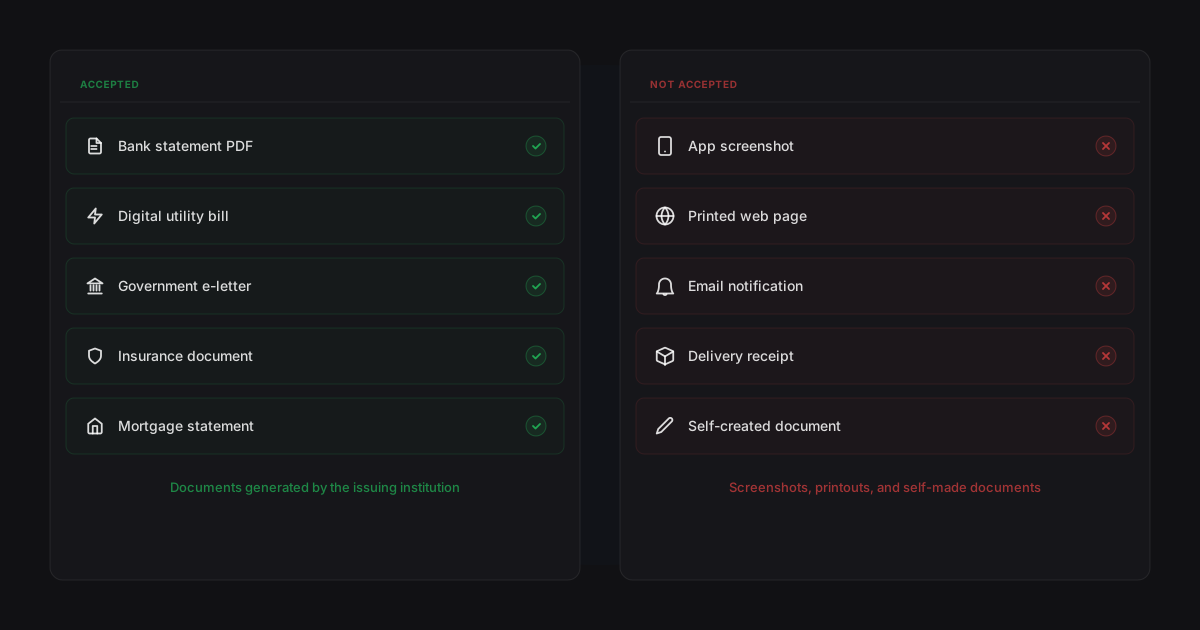
A digital proof of address is any electronically generated or delivered document that confirms a person's residential address. The most common types:
- PDF bank statements downloaded from online banking portals
- E-bills from utility companies (gas, electricity, water, internet) delivered by email or available in an online account
- Digital government correspondence such as tax notices, voter registration confirmations, or council tax bills accessed through government portals
- Insurance documents sent electronically by insurers
These are distinct from scanned paper documents, where someone takes a physical letter and scans or photographs it. Scanned documents are also widely accepted but carry different verification considerations (image quality, potential for tampering).
What regulators say
Regulatory guidance on digital documents has evolved significantly. Most major jurisdictions now accept them, with conditions.
European Union
The EU Anti-Money Laundering Directives (AMLD4, AMLD5, and the upcoming AMLR package) require "reliable, independent source documents" for customer verification. They do not distinguish between paper and digital formats. A PDF bank statement downloaded from a regulated institution qualifies, provided it meets the standard criteria: recent (typically within 3 months), shows the customer's name and address, and is issued by an independent third party.
United Kingdom
The FCA and Joint Money Laundering Steering Group (JMLSG) guidance explicitly recognises electronic documents. Their guidance notes that "evidence of identity can be obtained electronically" and that firms should assess the reliability of the source rather than the medium. Digital bank statements from regulated UK banks are widely accepted.
United States
Under the Bank Secrecy Act and FinCEN's Customer Identification Program (CIP) rule, financial institutions must verify customer identity using "documents, non-documentary methods, or a combination." The rules are format-neutral. PDF statements from US banks and utility providers are routinely accepted.
Other jurisdictions
Singapore (MAS), Hong Kong (HKMA), Australia (AUSTRAC), and most other regulated markets follow similar principles. The trend is clear: regulators care about the source and reliability of the document, not whether it arrived on paper or as a PDF.
What is not accepted
While digital documents are broadly accepted, certain formats are typically rejected:
- Screenshots of banking apps or websites. A screenshot is trivially easy to edit. Most compliance policies require the original PDF as downloaded from the institution, not a screen capture.
- Printed web pages. Saving a webpage as PDF or printing it does not make it a valid proof of address. The document must be generated by the institution itself.
- Emails without attachments. An email notification saying "your bill is ready" is not a proof of address. The actual statement (usually attached as a PDF or accessible via a link) is what counts.
- Documents from unregulated sources. Subscription receipts, delivery confirmations, app notifications, and similar documents from non-regulated companies do not qualify regardless of format.
- Expired documents. Digital or not, a statement older than the accepted threshold (usually 3 months) will be rejected.
Challenges with digital documents
Digital proof of address documents introduce specific verification challenges that paper documents do not.
Easier to forge
A PDF is fundamentally easier to edit than a printed letter. Anyone with a PDF editor (or even a free tool like Sejda or Photopea) can open a real bank statement, change the name and address, and re-export it. The result is a pixel-perfect forgery that passes casual visual inspection.
This is why metadata analysis matters. A genuine bank statement PDF will have metadata showing it was generated by the bank's document system. A forged one will show it was last modified in Adobe Acrobat, Photoshop, or a similar editing tool. Checking the PDF producer, creation vs. modification dates, and revision count catches many forgeries automatically.
No physical characteristics
Paper documents have physical properties that provide implicit authenticity signals: letterhead quality, watermarks, paper weight, ink consistency. Digital documents have none of these. Verification must rely entirely on the document's content, structure, and metadata.
Format inconsistency
Every bank, utility, and government agency generates PDFs differently. Some produce clean, structured PDFs with embedded text layers. Others generate image-only PDFs (essentially scanned documents saved as PDF). Some use unusual fonts, encodings, or layouts. A verification system needs to handle all of these consistently.
Password-protected PDFs
Some banks deliver statements as password-protected PDFs (often using the customer's date of birth or account number as the password). These need to be decrypted before they can be processed, which adds a step to the verification flow and requires the customer to provide the password.
How to verify digital proof of address
A robust verification process for digital documents should check several layers.
Content extraction
Extract the key fields from the document: recipient name, address, document type, and issue date. For PDFs with embedded text, this can be done by reading the text layer directly. For image-based documents (photos of letters, scanned PDFs without text layers), OCR or AI-based vision models are needed.
Data matching
Compare the extracted fields against the expected values. Name matching needs to handle variations (abbreviations, middle names, transliterations for non-Latin scripts). Address matching needs to handle formatting differences (e.g., "St." vs. "Street", "Apt 4" vs. "Apartment 4"). Fuzzy matching with configurable thresholds is essential.
Document classification
Verify that the document is actually the type it claims to be. A customer submitting a marketing email or a delivery receipt instead of a utility bill should be automatically flagged. Automated classification catches this without human review.
Date validation
Check the document's issue date against your accepted window. Most policies require documents issued within the last 3 months. This is a simple check but one that manual reviewers frequently miss, especially when handling high volumes.
Fraud signals
Check the document's metadata for signs of tampering. For PDFs: producer/creator fields, creation vs. modification dates, revision count, and text layer consistency. For images: EXIF data, noise analysis, and compression artifacts. These checks are fast, automatic, and catch a significant percentage of forged documents.
The shift to digital-first verification
The transition from paper to digital proof of address is irreversible. Younger customers may never receive a paper utility bill in their lives. Banks are actively discouraging paper statements (some charge extra for them). Government services are moving online across the world.
For businesses running KYC and AML checks, this means two things:
- Your verification process must handle digital documents natively. If your workflow still assumes paper documents that get scanned, you are creating friction for your customers and slowing down onboarding.
- You need automated fraud detection. The ease of editing digital documents means manual visual review alone is not sufficient. Metadata checks, structural analysis, and AI-based verification need to be part of the process.
How trusqo handles digital documents
trusqo is built for digital-first proof of address verification. Submit a PDF, image, or scanned document via API, and trusqo handles the rest:
- AI-powered extraction of names, addresses, dates, and document types from any format, any language
- Fuzzy name and address matching with configurable thresholds
- Automatic document type classification and date validation
- PDF metadata analysis and fraud detection (producer checks, revision counting, text layer mismatch detection)
- Image forensic analysis for photographed documents (noise analysis, block variance, error level analysis)
- Downloadable PDF audit reports for compliance records
Whether your customer uploads a PDF from their banking app or a photo of a letter from their phone, the verification process is the same: fast, consistent, and auditable.
Full API documentation is available at trusqo.com/docs.